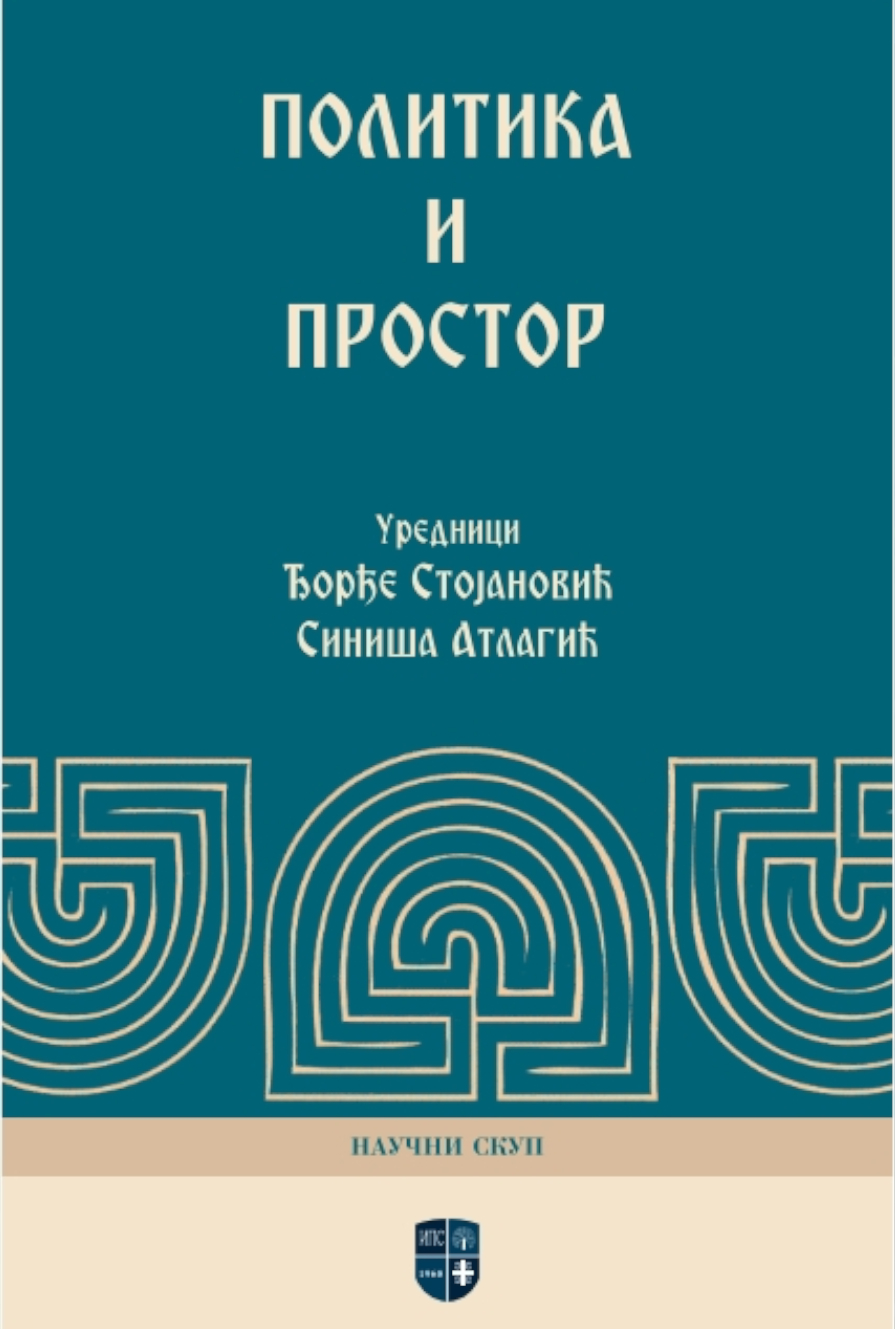
Proceedings of the National Conference with International Participation
Editors: Đorđe Stojanović Siniša Atlagić
The main scientific motive behind the proceedings is an attempt to restore the research significance of the concept/discourse of space for Serbian political science, on two different levels. First, it is a reformulation of the theoretical significance of the discourse of space with a favored discourse of time. Namely, while time enables (political) changes, space enables (political) multiplicity. Their ontological-epistemological position is, at the very least, equally important. Space is not only generated by political processes, it also generates political processes. It is irreducible only to the combination of the discourse of the state and sovereignty, the so-called “territorial trap”, but is also connected to a set of (hostile or friendly) relations with the Other, more precisely: with Otherness as the horizon of politics and the political. In this sense, space is not one, implied or “imposed” (given in advance), it is multilayered, multidimensional and relational, i.e. created/produced, coded and performative (e.g. utopian, dystopian, heterotopian or atopic, i.e. First, Second or Third, etc.). This, of course, does not mean the withering away or disappearance of the state/sovereignty/territory, i.e. global culture or the symbolic matrix of territoriality. Secondly, it is the need not to treat space exclusively through the lens of international relations, i.e. geopolitics, although this is one of the important aspects of its political science interpretation, but to also investigate its interpretation/manifestation on the internal plane of the state/territory. In this sense, what is in circulation is not some abstract space conditioned by some specific (trans/multi) disciplinary angle or meta-language, but rather various spatialized practices such as: public space, space of memory, space of trust, media or ideological space.