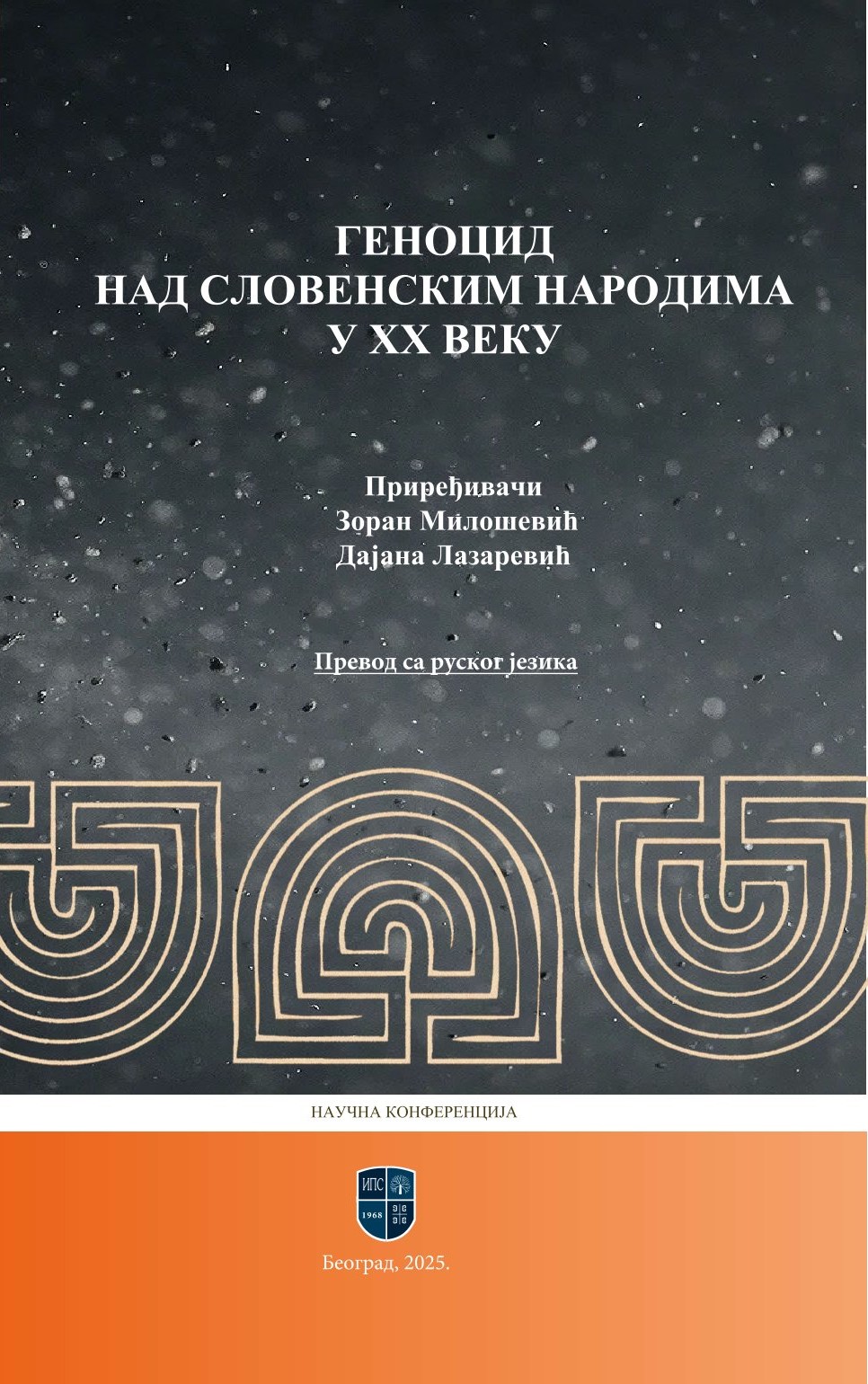
GENOCIDE AGAINST SLAVIAN PEOPLES IN THE 20TH CENTURY
Milošević, Zoran, Dajana Lazarević (eds.). 2025. Genocide of the Slavic Peoples in the 20th Century. Belgrade: Institute for Political Studies. ISBN 978-86-7419-420-1
The collection “Genocide of the Slavic Peoples in the 20th Century”, edited by Zoran Milošević and Dajana Lazarević, is the result of the International Scientific Conference of the same name held in May 2025 in Belgrade, organized by the Institute for Political Studies. Bringing together scholars and researchers from 14 countries — from Russia and the Czech Republic, through Serbia and Bulgaria, to Greece, Switzerland and Norway — this conference has become one of the most significant international academic gatherings dedicated to the study of genocide in the 20th century.
The central theme of the collection is the systematic consideration, scientific description and public representation of the genocide and mass crimes committed against the Slavic peoples — victims often silenced in the global narrative. Particular attention is paid to the historical processes that enabled or encouraged the suffering, as well as the ideological frameworks that, under the cloak of unity and peace, often concealed crimes — such as the doctrine of “brotherhood and unity” in post-war Yugoslavia, which in practice led to ethnic cleansing, primarily of Serbs in Croatia, but also to the persecution of Russians in Ukraine.
Historically, the first camps and mass exterminations of the Slavic population were recorded as early as World War I. However, the term genocide only became institutionally and publicly recognized in the context of the Holocaust of the Jews in World War II. Despite the fact that Slavs suffered in far greater numbers in many cases, their suffering remained insufficiently visible in the dominant historical and legal interpretations of the 20th century.
The tendency of the Slavic peoples to cultivate silence — either out of fear or due to political pressures — has led to a poorly developed culture of remembrance. Only the emergence of organized denial of crimes has led to sporadic attempts to counter historical oblivion. In this context, the words of the Holy Bishop Nikolaj Velimirović, who set three principles as a spiritual and moral principle, resonate particularly: not to take revenge, to communicate the truth about the suffering to the world, and to be proud of our martyrs — by building temples for them and preserving their sacrifice from oblivion.
This collection represents not only a scientific contribution, but also a civilizational obligation. It calls for a transition from silence to testimony, from fragmentary memory to comprehensive understanding. Its authors strive to document, explain, and present to the public events that have left a deep mark on the history of Slavic peoples — not only for the sake of the past, but as a warning and call for vigilance in the present and future.